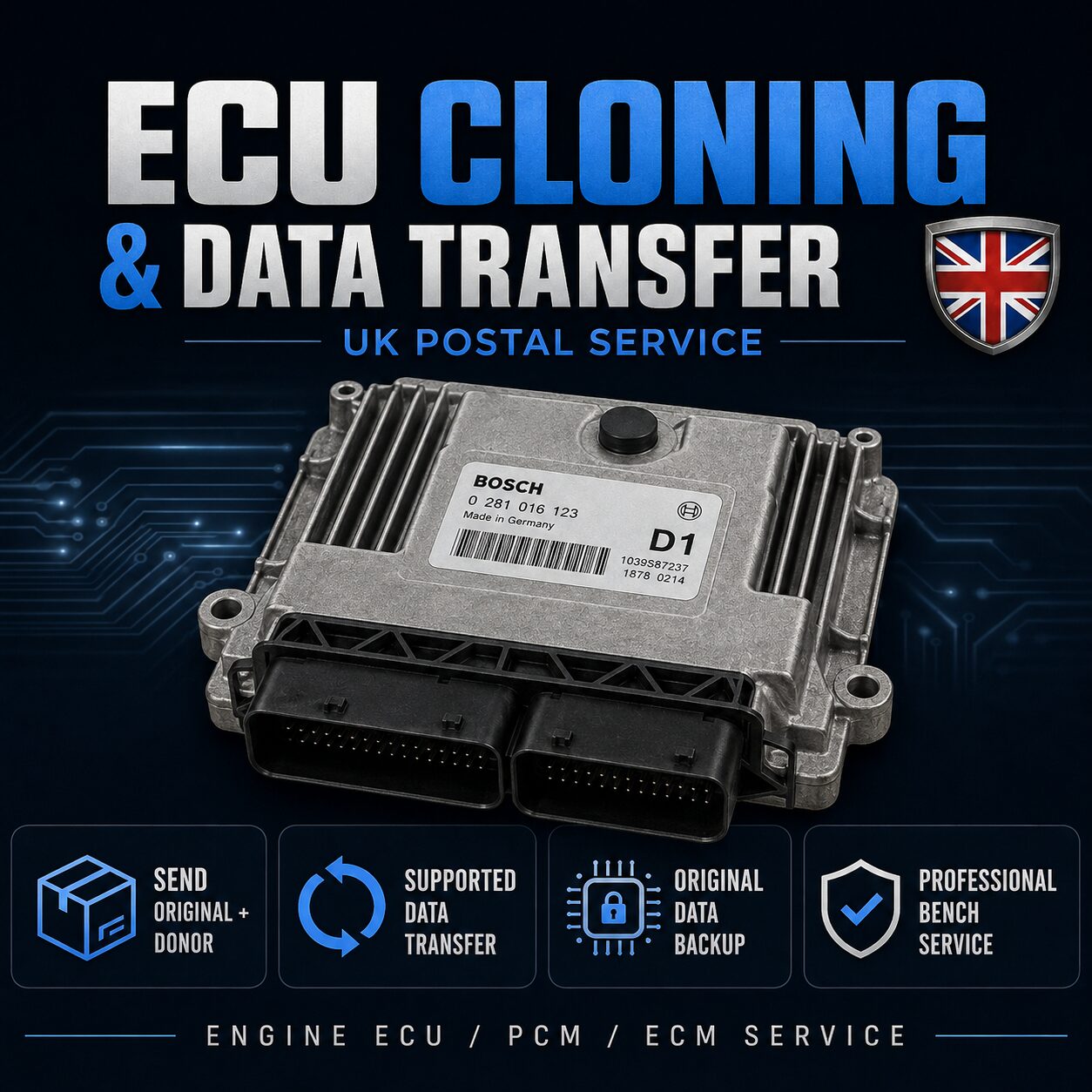
Replacing an engine ECU can involve more than matching its connectors. GEM’s cloning service transfers supported vehicle-specific information from a readable original ECU to a technically compatible donor, with both customer-supplied units returned.
What data is involved in ECU cloning?
The shop service covers supported immobiliser, coding, calibration and other vehicle-specific data. Which information can be read and transferred depends on the ECU family and memory configuration. A successful transfer is not a full functional test of the donor or vehicle.
Before buying an ECU donor
Keep both label photographs and the vehicle application together. An apparently similar ECU may differ in hardware or memory layout, so ask about compatibility before buying a donor. If the original is unreadable, the advertised cloning route may not be possible.
Two modules are required
Send your original engine ECU and a compatible donor/replacement unit. The cloning price covers labour for the advertised procedure; it does not include a donor. If you need help sourcing one, contact GEM first. Any proposed donor and extra cost must be agreed before purchase.
Module and donor requirements and readable data
Part number, hardware version, processor, memory configuration and the condition of both units affect support. Similar casings or connectors are insufficient. The original must contain readable supported data; water, fire, corrosion, severe PCB damage or previous incorrect programming can prevent a transfer.
How to arrange the postal service
- Use the product page to check the service scope and current ordering details. Send clear label photographs if compatibility is uncertain.
- Have both modules removed using the relevant manufacturer procedures by a suitably qualified person.
- Pack securely in anti-static protection and a strong padded box; protect the connectors. Mark the units ORIGINAL and DONOR and pack them separately. Include your order number, contact details, vehicle information and fault description.
- Confirm the delivery address and send the parcel using tracked postage. You arrange and pay for inbound delivery.
- GEM assesses the supplied units and carries out the supported, agreed work. If the required procedure is unsuitable, further action is discussed first.
- The supplied modules are returned using the applicable return-shipment service. Review return costs and available cover at checkout.
Ask for the current turnaround estimate before posting. Timing depends on module condition, support and workload; no fixed completion date or successful outcome is guaranteed.
What happens after the modules are returned?
Arrange installation and any required vehicle diagnostics, coding or calibration. The agreed bench transfer does not include those tasks or repairs to other vehicle systems. Successfully copying data is not proof that every donor circuit is healthy. Both supplied modules are returned, and additional work requires prior agreement.
UK-wide postal service: all cities, towns and rural areas
You can send a suitable module from anywhere in England, Scotland, Wales or Northern Ireland. Customers throughout the UK use the same online ordering and postal process. GEM is based in Birmingham; nationwide coverage means postal module work, not a claim of a local workshop or mobile visit in every city. Follow the paid-order instructions for dispatch; ask GEM if unsure which service to order.
Can I send only a replacement module?
Not for this original-to-donor cloning procedure. GEM needs the original supported data source as well as the compatible donor. Confirm the scope before sending a unit if the original has been lost or cannot be read.
Read the service terms and conditions alongside the product listing.
View the service and arrange your order
Check the current price, service requirements and full service terms before ordering. This is work on customer-supplied electronics; the photographed module is not a replacement unit for sale.
Ford SID212EVO donor programming case study
See how GEM completed Ford SID212EVO ECU replacement programming through FDRS PMI, using a communicable original and a compatible donor. The case study explains the difference from direct memory cloning and the checks still needed after refitting.
Arrange the appropriate ECU service
ECU cloning service is the primary route for a supported original/donor transfer. Compare ECU repair if you want the original assessed, or OEM programming for an in-vehicle procedure.