A faulty Ford SID212EVO engine ECU does not always need the same solution. Some units can be repaired; others need a compatible replacement and a supported programming route. In this workshop job, the original ECU had developed a serious electronic fault and was no longer considered suitable for continued use or economical repair. A compatible donor ECU was obtained, and GEM Electrical & Mechanical Repairs successfully prepared it on the bench using Ford FDRS.
The important detail is how that result was achieved: the original still communicated sufficiently for Ford’s Programmable Module Installation (PMI) workflow. We retrieved the required vehicle/module information, connected the replacement when instructed and completed its programming and configuration. FDRS confirmed: “Module installation was successful.”
This is a case study of Ford SID212EVO ECU replacement programming, with useful context for owners and garages asking about ECU repair, cloning or donor preparation. GEM is based in Birmingham, West Midlands, and accepts suitable ECU work by post from across the UK after compatibility has been confirmed.
Ford SID212EVO ECU identification
The job concerned the Ford SID212EVO family used in the Transit / Tourneo Custom application described below. Correct identification comes before a donor purchase: similar-looking units can have different hardware, software or vehicle requirements.
| ECU family | Ford SID212EVO |
|---|---|
| Application in this case | Ford Transit / Tourneo Custom |
| Engine | 2.0 EcoBlue / Panther diesel |
| Programming route | Ford FDRS – PCM Programmable Module Installation |
| Service carried out | Bench programming and compatible donor ECU replacement preparation |
| Confirmed bench outcome | Successful module installation reported by FDRS |
For your own enquiry, send a clear photograph of the complete ECU label. We check the actual part and hardware references rather than identifying compatibility from the casing or this workshop image. Private vehicle and module identifiers are not reproduced in this article.
The original ECU fault
The original module had a serious fault that made continued service unsuitable. That does not mean it was completely dead or unreadable. An ECU can retain enough communication for a replacement procedure while still being unfit to operate reliably in the vehicle.
Physical ECU repair is sometimes practical, but condition, damage and the available repair route determine whether it makes sense. In this case, donor replacement programming was the chosen route. We are not attributing the fault to a particular internal component because that level of failure analysis is not documented here.
The wider BCM and ECU repair guide explains why a fault code or communication problem alone should not condemn a module. Vehicle supplies, grounds and network faults need appropriate diagnosis too.
Why a used donor ECU cannot simply be plugged in
A Ford powertrain control module, or PCM, carries software and configuration associated with its application. A used unit may contain information from its previous vehicle. Matching connectors and a similar casing do not establish that its hardware or programming is suitable for the intended replacement.
Part numbers, hardware revisions, software support and vehicle specification all matter. Programming or configuration may be needed, and immobiliser/security adaptation can be a separate requirement depending on the vehicle. Buying a donor before these checks can leave an owner with an unsuitable part.
Our Used ECU Replacement & Coding service starts with those compatibility questions. A successful result on this SID212EVO does not establish that every used Ford PCM can be prepared by the same method.
Professional bench programming setup
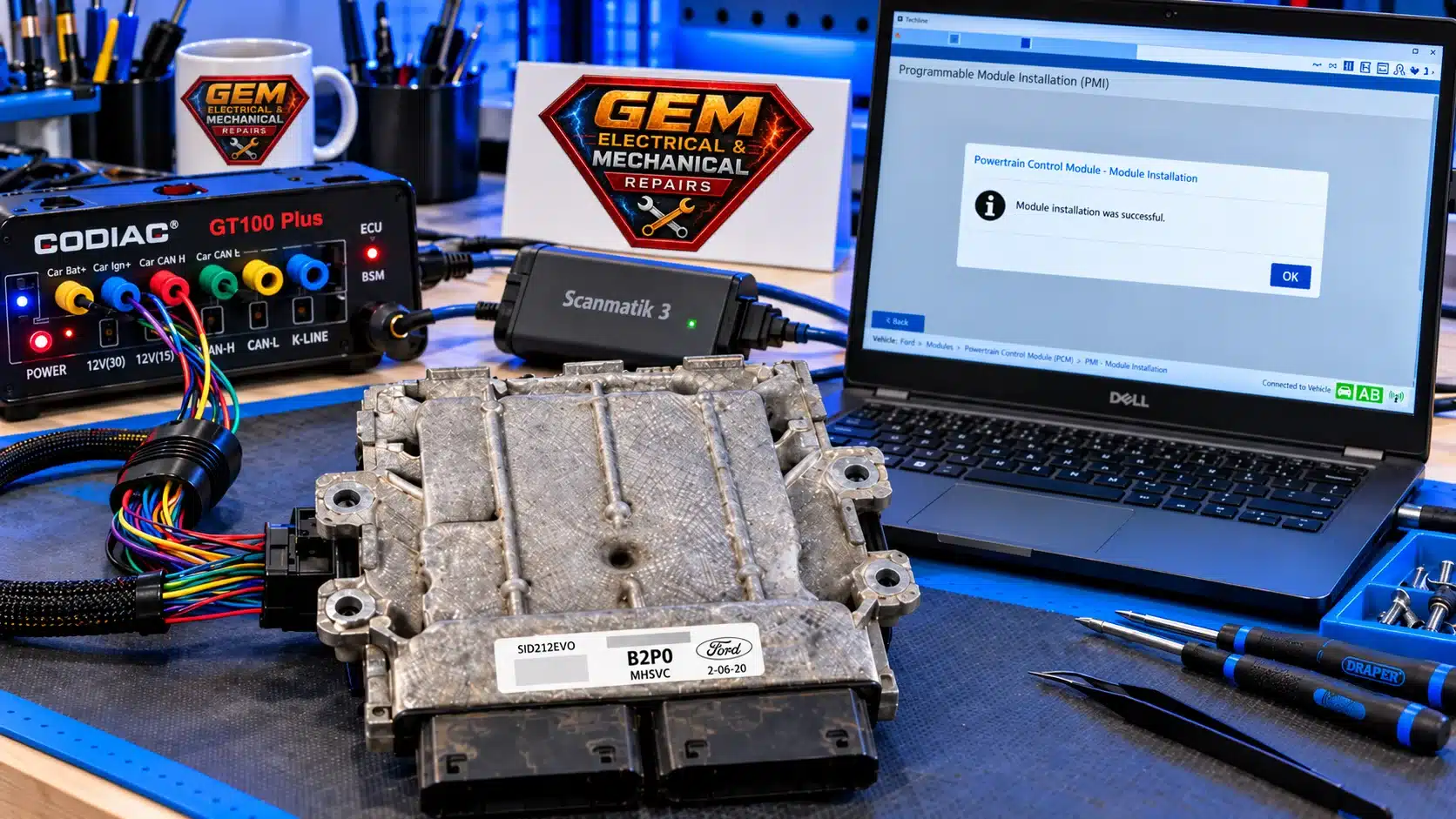
GEM used a controlled bench setup to power and communicate with the modules outside the vehicle. The equipment included Ford FDRS, a Scanmatik 3 J2534 interface, GODIAG GT100 Plus GPT / ECU breakout bench equipment and a regulated, stabilised power supply.
The setup provided the relevant permanent supply, ignition/wake supply and CAN communication connections. Stable power and reliable communication matter throughout a programming session: an interruption can prevent the process completing. The breakout equipment supported the physical bench connections, while FDRS managed the manufacturer programming workflow.
This description explains the service carried out; it is not a wiring guide. Bench connections must be appropriate to the exact module. Equipment names alone do not establish support for another ECU or replace the relevant technical information and professional checks.
Reading the original ECU and vehicle information
The original ECU was connected first. Despite its fault, FDRS could communicate sufficiently to obtain the information required for this replacement procedure. Preserving that opportunity was important: discarding an original unit too early can remove information that may help prepare its replacement.
We followed the original-module stage of the PMI workflow before swapping units. This was a supported diagnostic read for replacement programming, not a claim that every memory area was recovered or that a complete EEPROM or MCU backup was created.
If an original will not communicate, the available options must be assessed separately. Supported automotive module data recovery may help in some cases, but unreadable, damaged or corrupted data can limit what is achievable.
Programming the compatible donor through Ford FDRS
With the original-module information obtained, the compatible donor was connected on the bench when FDRS instructed the replacement stage. We used the PCM – Programmable Module Installation (PMI) procedure to program and configure the replacement using information associated with the original vehicle.
During the procedure, FDRS successfully updated the replacement module software. The session finished with the on-screen confirmation “Module installation was successful.” That is the result illustrated in the featured workshop image.
Software selection is vehicle-dependent. The appropriate software and calibration must come from the relevant Ford system information and the actual application; another vehicle should not be programmed by assuming this example establishes its requirements. Ford’s own published programming instructions also refer to FDRS PMI, although that document is not a SID212EVO compatibility guide.
Was this an ECU clone?
Customers often describe donor ECU preparation as “ECU cloning”. The term is useful when discussing the desired replacement, but different technical methods can sit behind it. A direct bench clone may involve transferring supported EEPROM, flash, MCU or security data from an original unit to a compatible donor.
This SID212EVO job used Ford’s official PMI process to program and configure a compatible replacement PCM. We are not describing it as a literal byte-for-byte EEPROM or MCU clone, and FDRS completing PMI does not prove that such a copy took place.
GEM assesses supported repair, data transfer and replacement-programming routes according to the original’s condition and the donor’s compatibility. See ECU Cloning & Module Programming for the broader service. Neither the family name nor a previous successful job guarantees cloning support for every SID212 or SID212EVO.
What happens after bench programming?
Successful bench PMI is a useful, specific result. The replacement still needs to be installed in the vehicle and checked as part of the complete system. The vehicle network should be scanned, diagnostic trouble codes reviewed and cleared where appropriate, and the original symptoms reassessed.
Depending on the vehicle and procedure, PATS/security synchronisation or additional relearns and adaptations may be required. Wiring, supply or other module faults can remain even when PCM programming has completed successfully. Bench programming alone does not establish that every immobiliser issue has been resolved.
This case study records the successful programming stage; it does not claim a documented road test or guarantee immediate plug-and-play operation. Agree the expected bench deliverable and the remaining in-vehicle work before sending an ECU.
Can GEM repair or program your SID212EVO?
We welcome enquiries for SID212 / SID212EVO assessment, ECU fault diagnosis, supported electronic repair, donor compatibility checking, Ford PCM replacement programming, supported data recovery and cloning/data transfer. This includes Ford Transit and Transit Custom ECU enquiries.
Each module is assessed individually. The fault history, communication status and exact identification determine which route is available. Our Ford electrical service information also covers wider vehicle diagnostic enquiries where the problem may extend beyond the ECU.
What to send GEM before posting
Send the following information so we can review support and advise on the next step:
- Vehicle make, model and year.
- Engine details.
- A clear photograph of the complete original ECU label.
- Diagnostic fault codes and relevant scan findings.
- A description of the symptoms and when they occur.
- Whether the ECU currently communicates.
- Details of previous repair or programming attempts.
- A donor label photograph if you already have a replacement.
Wait for confirmation of compatibility, the agreed work and delivery details before dispatch. If donor work is agreed, clearly label the two units ORIGINAL and DONOR. Use suitable anti-static protection, protect the connector pins and place the modules in a strong, well-padded box. Send them by tracked delivery with the agreed job/contact details enclosed.
UK-wide Ford SID212EVO ECU repair and programming by post
GEM Electrical & Mechanical Repairs is based in Birmingham, West Midlands. Our postal ECU service supports suitable enquiries from England, Scotland, Wales and Northern Ireland. Contact us first, confirm compatibility and then send the agreed original and donor units by tracked post.
The same postal process is available to customers in London, Manchester, Liverpool, Leeds, Sheffield, Bristol, Nottingham, Leicester, Derby and Stoke-on-Trent. It also serves Newcastle upon Tyne, Sunderland, York, Hull, Norwich, Cambridge, Oxford, Reading, Southampton, Portsmouth, Brighton, Plymouth and Exeter.
Customers in Cardiff, Swansea, Newport, Glasgow, Edinburgh, Aberdeen, Dundee and Belfast can use the same enquiry route. Closer to Birmingham, enquiries from Coventry, Wolverhampton, Walsall, Dudley and Solihull are welcome too. These are examples of postal coverage, alongside other UK towns and rural areas.
Nationwide coverage means postal module work, not a claim of a local workshop or mobile attendance in every city. Any selected local mobile/on-site visit by GEM to the vehicle must be agreed separately, subject to job suitability and availability. Ask about current turnaround and the scope of work before posting; neither a completion date nor a successful repair can be assumed before assessment.
Why choose GEM Electrical & Mechanical Repairs?
GEM combines professional diagnostics with bench electronics work, module repair experience and manufacturer-level programming where available. That allows the enquiry to start with the practical question: can the original be repaired, can useful information be recovered, or is compatible donor programming the appropriate route?
We explain the proposed work before proceeding and distinguish bench results from the checks needed after refitting. Our BCM & ECU repair service and ECU cloning and data-transfer service describe related options; confirm SID212EVO support before ordering.
Frequently asked questions
Can you repair a Ford SID212EVO ECU?
Potentially, depending on the fault, condition and supported repair options. Send the ECU label and diagnostic findings first. Some units need replacement rather than physical repair.
Can you clone a Ford SID212EVO ECU?
Support depends on the exact unit, readable data and donor compatibility. This case used Ford PMI replacement programming, not a literal EEPROM or MCU clone. We assess the appropriate route individually.
Can you program a used Ford Transit ECU?
A compatible used ECU may be suitable for supported replacement programming. Hardware, software and vehicle requirements must be checked before you buy or send a donor.
Can I post my ECU to GEM Repairs?
Yes, suitable jobs can be arranged by tracked post across the UK. Contact GEM first and wait for confirmation of support, the agreed work and delivery details.
Do I need to send the original ECU?
For the workflow described here, the original was needed and remained sufficiently communicable. Keep your original and explain its condition; we will confirm what is needed for your job.
Do I need to send a donor ECU?
Send a donor only when replacement work and compatibility have been agreed. An enquiry about repair does not automatically require a donor, and a replacement unit should not be assumed to be included.
Can you help if my original SID212EVO is water damaged?
We can review the enquiry, but corrosion and damage may prevent repair or information recovery. Send photographs and the fault history. Do not assume that a water-damaged ECU will support the PMI read used in this case.
Does a donor ECU need PATS programming?
It may need security synchronisation depending on the vehicle and replacement procedure. Successful bench PMI does not by itself establish that all PATS or immobiliser requirements have been completed.
Will a programmed ECU be plug-and-play?
That cannot be promised without checking the application and agreed procedure. In-vehicle scanning, security work, relearns or adaptations may still be needed after installation.
How do I identify my Ford SID212EVO ECU?
Send a sharp photograph of the complete original label and any diagnostic module identification. GEM checks the actual part and hardware references; casing shape or a family name alone is insufficient.
Do you cover London, Manchester, Scotland, Wales and Northern Ireland?
Yes, through the same UK-wide postal service for suitable modules. GEM is based in Birmingham and does not claim a workshop or mobile attendance in each location.
How long does ECU repair or programming take?
Ask for a current estimate when support is confirmed. Module condition, donor suitability, required procedures, parts and workload affect turnaround; no fixed completion time applies to every enquiry.
Ask GEM to confirm SID212EVO support and donor compatibility
Send us a clear photograph of your ECU label and fault codes before posting the module. Contact GEM Electrical & Mechanical Repairs, Birmingham, West Midlands through gemrepairs.co.uk, email info@gemrepairs.co.uk, or call / WhatsApp 07300 072614.
Arrange a UK-wide postal module assessment
Send the module identification and fault details first. GEM confirms the supported work and what to post before you purchase or dispatch. See how the postal service works.
Does the job need manufacturer programming?
Cloning, electronic repair and OEM programming are different routes. If the complete vehicle must be connected, GEM checks remote programming through your garage first; selected mobile/on-site support in Birmingham and surrounding West Midlands areas may be available by arrangement. Compare the programming and postal options, and send both module details before buying a donor where possible.