A non-starting vehicle, lost module communication or failing body functions can raise suspicion about a BCM or ECU. Those symptoms do not establish that the electronic unit itself has failed. GEM’s BCM and ECU repair service starts with the module identification, fault history and appropriate diagnosis before recommending repair, cloning or replacement.
What does a BCM do?
The body control module manages or coordinates supported body and comfort functions, such as lighting, locking and windows, depending on the vehicle architecture. The same symptom can involve the BCM, its power supply, wiring or a connected component. Knowing which functions fail and when they fail helps guide diagnosis.
What does an engine ECU do?
The engine control unit uses information from sensors and other systems to control relevant engine functions. A fault code or no-start complaint does not prove the ECU needs replacement; electrical supply, network and external circuit problems can produce similar symptoms.
Common ECU and BCM fault enquiries
Examples include no or intermittent communication, a module not being recognised, CAN bus codes, no-start conditions, lighting/output faults and a module losing communication when hot. Internal issues may involve relay faults, power supplies, burnt components, failed drivers, EEPROM/data corruption, water ingress or corrosion. Diagnosis establishes which, if any, applies.
Wiring fault or internal module fault?
Vehicle-side checks matter. A poor ground, inadequate supply, damaged connector or network fault can stop a healthy unit communicating. Postal testing gives access to the module rather than the complete vehicle, so supply the diagnostic findings and explain what has already been checked. Local mobile electrical diagnostics may be the more appropriate first step in Birmingham or the West Midlands.
How module testing informs the repair decision
GEM uses professional diagnostic and electronics equipment to assess supported faults. Visual inspection, relevant bench testing and review of the reported symptoms help determine the practical next step. After authorised work, applicable checks are repeated. A successful bench retest is not a substitute for testing the vehicle after installation.
Repair versus replacement
Retaining a repairable original ECU or BCM can preserve its vehicle-matched configuration and avoid an unsuitable donor. It may reduce some programming work or overall expense, but repair is not always possible or cheaper. Severe damage, unavailable parts or unsupported procedures can change the recommendation.
Where cloning and data transfer fit
Supported cloning moves relevant configuration, security and vehicle-specific data from the original to a suitable replacement. Readability and compatibility are essential. A donor is not automatically included in a repair service, and replacement may still require programming, coding or security adaptation. The separate ECU cloning service explains the original-and-donor requirements.
Why module numbers matter
Compatibility should be confirmed using the part number, hardware number, software version and diagnostic identification where relevant. MCU, EEPROM and flash configuration, immobiliser generation and vehicle architecture can affect cloning support. Matching the casing or connectors alone is not enough.
UK-wide postal ECU and BCM repair
Our UK-wide postal ECU and BCM repair service accepts suitable modules from England, Scotland, Wales and Northern Ireland. Customers in London, Manchester, Liverpool, Leeds, Sheffield, Bristol, Newcastle upon Tyne, Glasgow, Edinburgh, Cardiff, Swansea and Belfast use the same postal process as customers in other UK cities, towns and rural areas. Postal coverage does not imply a local workshop or mobile attendance in each city.
Birmingham and regional vehicle support
GEM is based in Birmingham and the West Midlands. Selected mobile/on-site vehicle diagnosis by GEM at the vehicle location can be arranged where the job, location and availability allow, including enquiries from Wolverhampton, Walsall, Coventry, Dudley and Solihull. If the vehicle cannot be properly assessed on the bench alone, we explain which in-vehicle checks are needed.
Turnaround, pricing and warranty
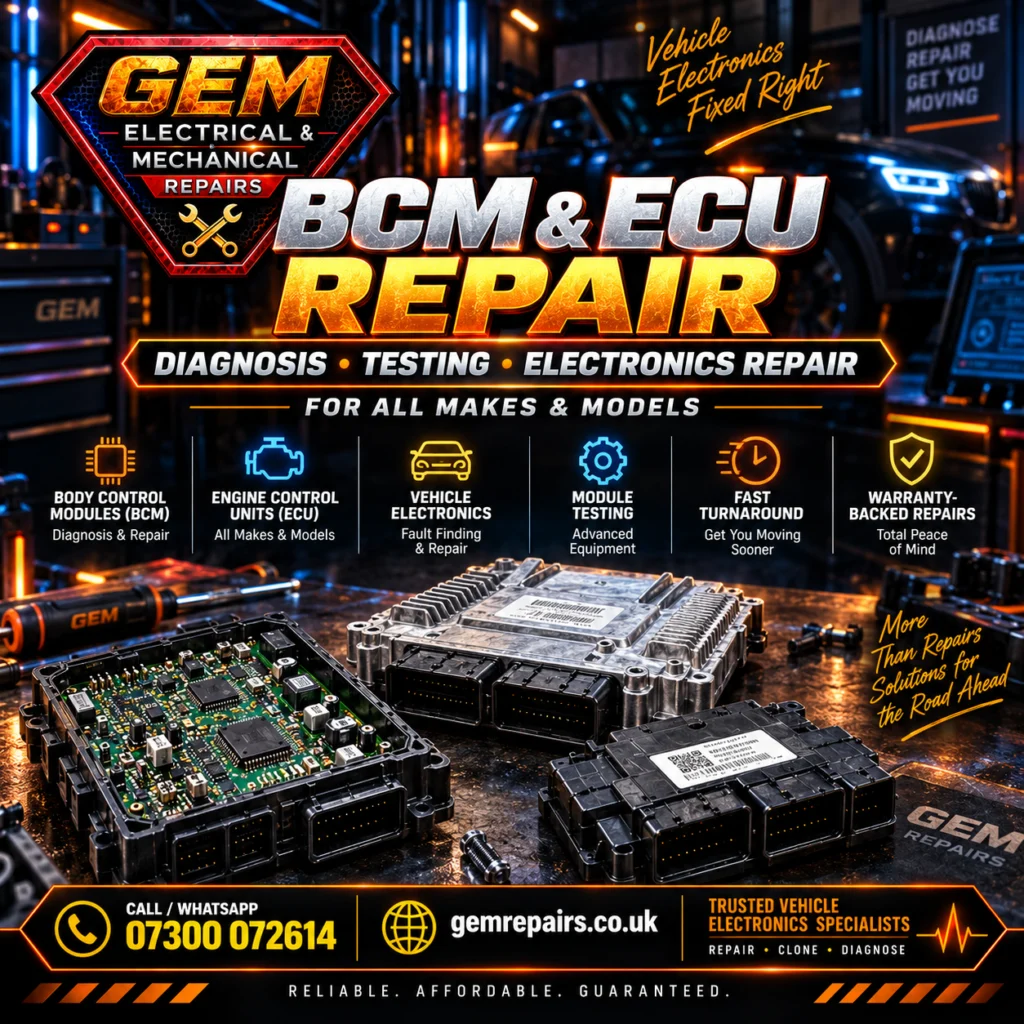
Some work cannot be confirmed until diagnosis. Contact GEM with the fault and module details before buying or sending parts, and agree the scope and price first. Fast turnaround is available where possible, with timing affected by parts, condition and workload. Promotional images are representative, not a promise that every unit can be repaired. Any workmanship warranty applies to the specific repair and period agreed in writing, subject to the service terms; no universal successful outcome or warranty period is implied.
How to send your module
- Contact GEM with the vehicle make, model, year, symptoms and diagnostic codes.
- Send clear module-label photographs and part, hardware and software references where available.
- Confirm the work and delivery details; have the module removed safely according to manufacturer procedures and package it securely.
- Post the electronic module using tracked delivery with your order and contact details enclosed.
- We inspect, test and diagnose the supported module using professional diagnostic and electronics equipment.
- Repair, cloning or data transfer is carried out only where technically possible and authorised.
- The unit receives the applicable bench retest; full in-vehicle operation still needs checking after installation.
- We securely return the supplied module; arrange refitting and any required coding, adaptation or vehicle checks.
Frequently asked questions
Can you repair any ECU or BCM?
No. Repair depends on the module design, fault, component availability and condition. We assess supported units before recommending repair, data transfer or replacement.
How do I know whether my BCM is faulty?
Body-function problems or a communication code do not prove an internal BCM failure. Vehicle wiring, power supplies, grounds, connected components and CAN/network faults may need checking before the module is removed.
Can you clone an ECU or BCM?
Where technically supported, relevant configuration, security and vehicle-specific data can be transferred from a readable original to a suitable donor. Compatibility and data condition must be checked first.
Will a repaired module need coding?
Retaining the original module may preserve its configuration, but coding, programming, calibration or immobiliser/security adaptation can still be necessary. This must be confirmed for the actual vehicle and procedure.
Do you work on all makes and models?
Enquiries are welcome for all makes and models, but this is not a claim that every module is supported. Part numbers, hardware/software identification and the actual fault determine suitability.
For SRS crash data rather than a BCM or engine ECU fault, see the separate Volvo airbag reset service. Key and immobiliser diagnosis is also available for appropriate vehicle enquiries.
Arrange BCM or ECU assessment
Read the full BCM and ECU service information, then confirm your module details and proposed work before ordering.
Ford SID212EVO donor programming case study
See how GEM completed Ford SID212EVO ECU replacement programming through FDRS PMI, using a communicable original and a compatible donor. The case study explains the difference from direct memory cloning and the checks still needed after refitting.
Choose the module-specific service
For an engine ECU, start with ECU repair assessment. For body electronics, see BCM/BSI/UCH repair. The combined module fault enquiry can help when the correct route is uncertain.