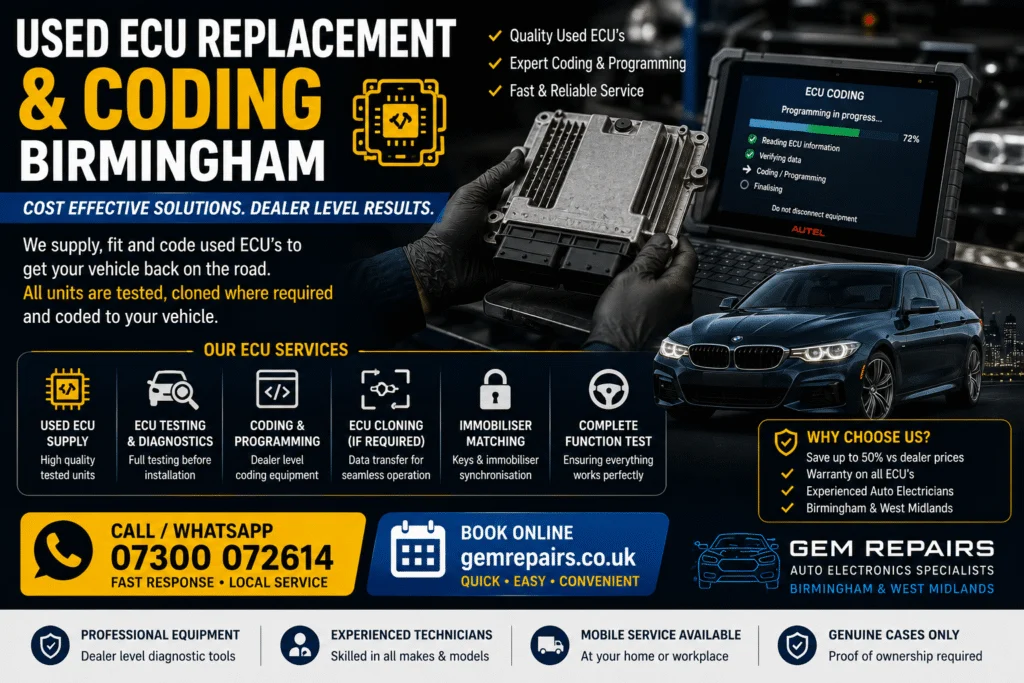
A used ECU can be less expensive than a brand-new unit, but it is rarely safe to assume that it will plug in and work. Vehicle-specific security and configuration data often mean the replacement must be cloned, reset, adapted or coded.
Check compatibility before buying
Compare the full hardware and software numbers on the original and donor labels. Vehicle make, model and engine are not enough on their own. Transmission type, emissions specification, production date and module revision may affect compatibility.
Why a used ECU may not start the car
The donor may still contain immobiliser data from its original vehicle. If that data does not match the key and security modules in the receiving car, starting may be blocked. Coding options vary: some units can be cloned, some reset and adapted, and others require manufacturer-specific online procedures.
Diagnose the original fault first
An ECU may be blamed for a wiring, sensor, power-supply or communication problem. Fitting another ECU without correcting the cause can waste money or damage the donor. Confirm powers, grounds and connected circuits wherever practical.
Information needed for an assessment
- Vehicle registration or full make, model, year and engine details
- Diagnostic fault codes and symptoms
- Clear photos of the original ECU label
- Photos of the proposed donor label
- Details of any earlier repair or programming attempt
Used ECU coding in Birmingham
GEM Electrical & Mechanical Repairs offers compatibility checks, cloning and coding support for suitable used replacement ECUs across Birmingham and the West Midlands.
Read about our used ECU replacement and coding service or send the module details before purchasing a donor.
Frequently asked questions
Must the part numbers match exactly?
Often they should, although approved supersessions may exist. Compatibility must be checked for the specific module.
Can coding fix a physically damaged ECU?
No. Hardware damage requires repair or a sound replacement before programming can succeed.
Ford SID212EVO donor programming case study
See how GEM completed Ford SID212EVO ECU replacement programming through FDRS PMI, using a communicable original and a compatible donor. The case study explains the difference from direct memory cloning and the checks still needed after refitting.
Check the job before buying a replacement
Use replacement ECU assessment to establish whether cloning or OEM programming is suitable. The vehicle, original data and donor all affect the answer.